Compliance Evidence Lineage and Chain of Custody: An Operational Guide
Build an operational chain of custody for compliance evidence from source collection through transformation, review, retention, and audit delivery.
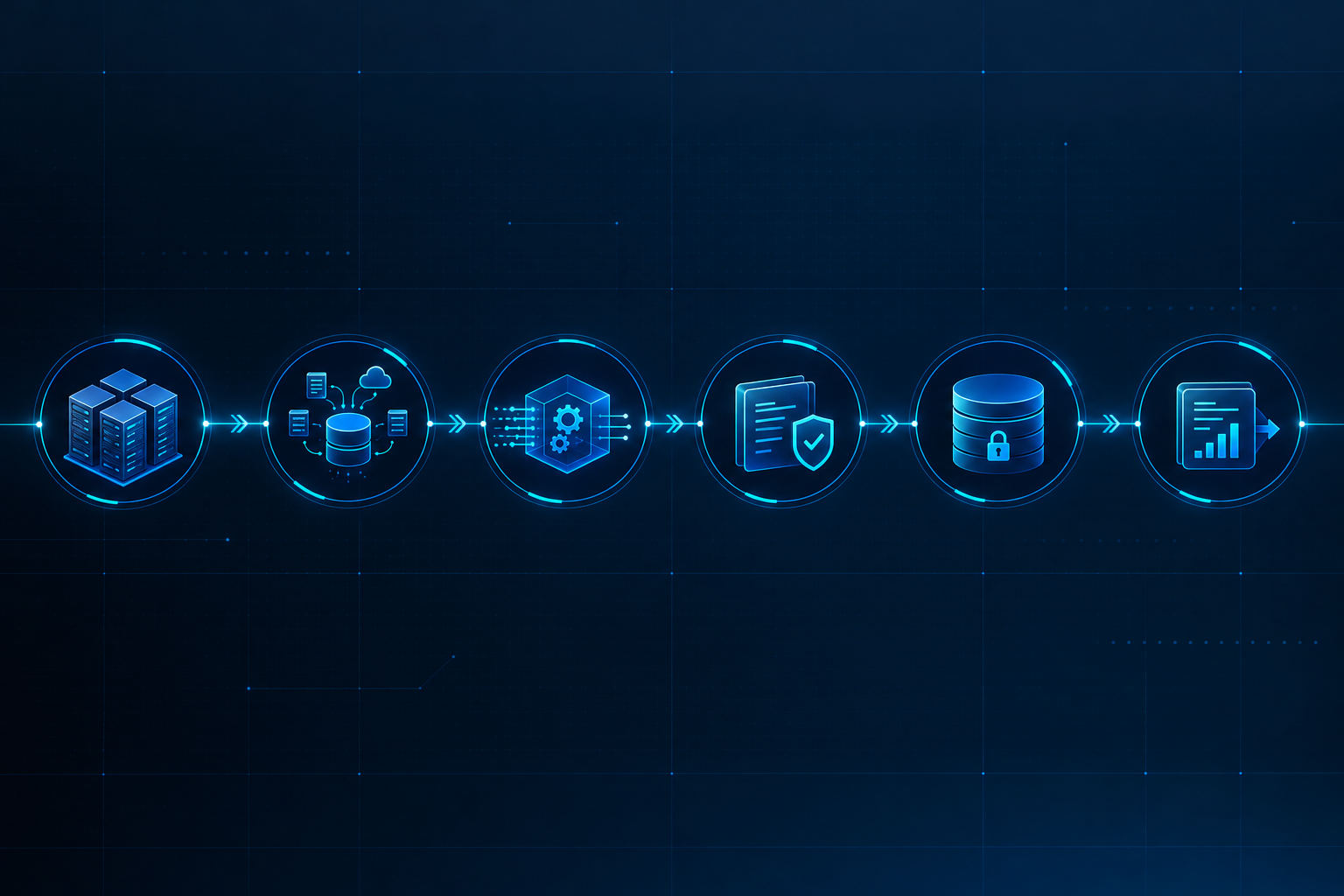
Audit evidence is only as defensible as the path that produced it.
A screenshot may show the right setting. A spreadsheet may contain the expected approvals. Neither artifact answers the harder questions by itself: Which system produced it? Who collected it? What query and scope were used? Was it transformed? Is this the version the reviewer accepted?
Evidence lineage connects those facts from source to final decision. It complements the acceptance tests in the compliance evidence validation workflow and the time rules in How to Set Compliance Evidence Freshness Rules and Detect Stale Proof. Validation asks whether evidence supports a claim. Freshness asks whether it still represents the required period or state. Lineage establishes how the evidence came to exist and whether the reviewed artifact is the same one later presented.
This guide defines an operational model for evidence chain of custody. It is part of the broader AI compliance automation guide, where collection, review, remediation, and reporting must remain connected rather than becoming separate document exercises.
What evidence lineage must prove
A useful lineage record should let a reviewer reconstruct five facts:
1. Origin: the authoritative system, tenant, account, repository, or device that produced the observation.
2. Collection: the identity, method, query, permissions, and time used to acquire it.
3. Transformation: every filter, join, normalization, redaction, or format conversion applied after collection.
4. Custody: who or what stored, accessed, reviewed, superseded, or exported each version.
5. Decision: the control claim, scope, period, acceptance test, and reviewer outcome supported by that version.
This is not the same as storing a filename and upload time. An upload event proves that a file entered a repository. It does not prove that the file represents the complete population, came from an authoritative source, or remained unchanged.
The companion workflow on designing compliance evidence provenance metadata defines the minimum fields needed to carry these facts consistently. The integrity workflow on verifying compliance evidence with hashes and immutable versions explains how to detect alteration and bind decisions to exact versions.
Define the lineage boundary
Start with the control claim, not the artifact.
For a quarterly privileged-access review, the claim might be: every active privileged identity in the production environment was reviewed by an authorized owner during the quarter, and required removals were completed.
The lineage boundary therefore includes more than the signed review workbook. It may include:
- The identity provider population export
- Privileged-role assignments from cloud platforms
- Human resources status used to identify departures
- The reconciliation logic that joins those populations
- The review task and owner decisions
- Removal tickets and completion evidence
- Reviewer acceptance and any documented limitations
- The retained package delivered to an auditor
Write down the first authoritative observation and the final reliance decision. Every material step between them belongs in the lineage graph.
Build the chain of custody
1. Register authoritative sources
Maintain a source registry that names the system owner, source type, tenant or environment, authoritative fields, approved collection methods, expected cadence, and access requirements.
Authority can be field-specific. An identity provider may be authoritative for account status, while a service catalog owns application criticality and a human resources system owns employment status. Record precedence instead of silently selecting whichever export is easiest to obtain.
When a source changes API versions, tenants, field meanings, or ownership, preserve the effective date. Historical evidence must remain interpretable under the source definition that existed when it was collected.
2. Record the collection event
Each collection needs a unique event record. Capture:
- Source identity and environment
- Collector identity or service account
- Collection time and applicable evidence period
- API endpoint, report definition, or query version
- Filters, pagination, and inclusion rules
- Permission context
- Result count and collection status
- Raw object location
- Error, retry, and partial-result state
A successful API response is not automatically a complete collection. If pagination stopped early or one account returned an authorization error, preserve that state and route the package for scope review.
The existing guide to automating SOC 2 audit evidence collection shows how evidence acquisition fits into a larger audit-readiness workflow. Lineage adds the records needed to explain each acquisition later.
3. Preserve the raw observation
Retain the raw output before normalization when policy and data-handling constraints allow it. Store it under an immutable object version or equivalent controlled version identifier.
The raw object provides a recovery point when a transformation is questioned. It also lets teams re-run improved logic without pretending the new result was the original artifact.
If raw retention is prohibited because the source contains sensitive data, record the approved minimization method, fields removed, responsible policy, and integrity reference for the minimized output. Data minimization should be a governed transformation, not an undocumented deletion.
4. Make transformations explicit
Compliance evidence often passes through useful processing:
- Converting timestamps to a standard zone
- Resolving account IDs to owners
- Joining ticket and deployment records
- Removing duplicate observations
- Mapping technical states to control criteria
- Redacting secrets or personal data
- Producing a reviewer-friendly table
Each step can change meaning or scope. Record the input versions, transformation name and version, parameters, execution identity, execution time, output count, exceptions, and output version.
Reconciliation checks should travel with the transformation. If an input contains 4,102 identities and the normalized output contains 4,087, the record should explain the fifteen excluded rows. Unexplained count changes are evidence defects.
5. Bind review decisions to versions
A reviewer should accept or reject a specific evidence version, not a mutable folder.
The decision record should include the artifact version, control claim, period, tested scope, acceptance criteria, reviewer identity, decision time, result, limitations, and linked rework or remediation.
If the package changes, the prior decision remains attached to the prior version. The replacement receives a new review. This prevents an accepted file from being edited in place after the reviewer has relied on it.
When a package fails an acceptance test, use the controlled response in How to Reject Incomplete Compliance Evidence and Manage Rework. Rejection, resubmission, and acceptance should form visible nodes in the same lineage rather than overwrite one another.
6. Control audit delivery
Auditor delivery is another custody event. Record the exact versions included, the export or portal transfer time, the recipient or request identifier, redactions, approvals, and any explanatory notes.
Do not create an untracked “final” zip file on a desktop. Generate the delivery package from accepted versions and retain a manifest. If a later request requires a narrower period or different scope, create a new package with its own manifest rather than replacing the first one.
Layer8 Compliance can coordinate collection events, evidence versions, review decisions, rework, and delivery references while keeping the operational record connected to the underlying control.
Handle common lineage breaks
Manual screenshots
A screenshot can be valid supporting evidence when it includes source context, relevant scope, collection time, collector, and an unambiguous view of the setting. Store it with a collection record. Screenshots copied into documents without source context are weak because their origin and completeness cannot be reconstructed.
Spreadsheet edits
If an owner adds classifications or review decisions to an export, preserve the raw export and treat the workbook as a derived version. Identify protected source columns, editable decision columns, and reconciliation totals. Do not allow sorting, filtering, or formula changes to silently remove population records.
Connector failures
A connector that loses one account or permission may continue producing plausible output. Compare observed source scope with expected scope. Mark partial collections explicitly and prevent them from inheriting the acceptance state of an earlier complete package.
Evidence reused across controls
One artifact may support several controls, but each reliance decision needs its own claim, scope, and acceptance result. Reuse the immutable version; do not duplicate the file into unrelated folders and lose the relationship to its origin.
Example: deployment approval evidence
A compliance team tests whether production deployments were approved before release.
The deployment platform produces 286 deployment records for the month. A pipeline joins commit identifiers to pull requests, maps pull requests to change tickets, and adds approval times. Twelve records fail to map.
A defensible lineage shows:
1. The deployment export and its collection event
2. The source query, environment, period, and result count
3. The pull-request and change-ticket input versions
4. The join logic version and matching rules
5. The 274 matched records and twelve exceptions
6. The reviewer decision that the matched population is valid evidence
7. The separate control result and remediation for unmapped deployments
8. The exact package delivered for audit review
The lineage does not turn exceptions into passing results. It preserves enough context to distinguish valid evidence of a failure from incomplete evidence.
Measure lineage health
Track measures that expose process defects:
- Evidence packages missing source identity
- Collections with partial or failed scope
- Transformations without reconciled input and output counts
- Review decisions attached to mutable objects
- Superseded versions still used in active requests
- Packages with undocumented manual handling
- Auditor deliveries that cannot be reproduced from a manifest
- Repeated lineage defects by source, control, and owner
- Time required to reconstruct a package from source to decision
Use these measures to correct collection queries, connector permissions, transformation logic, and review policy. Do not reduce lineage to a documentation-completeness score.
Conclusion
Compliance evidence lineage makes reliance reconstructable. The operating model is straightforward: register authoritative sources, record collection conditions, preserve raw observations, expose every material transformation, bind decisions to immutable versions, and track delivery custody.
The result is not more paperwork around an artifact. It is a connected record that lets security, compliance, and audit teams determine what was observed, how it changed, who relied on it, and which exact version supported the conclusion.
<!-- zero-content-links:start -->
Related Layer8 Labs guides
- Compliance Evidence Access Governance: An Operational Guide
- How to Detect and Investigate Unauthorized Compliance Evidence Deletion
- Explore Layer8 Compliance
<!-- zero-content-links:end -->