How to Collect SOC 2 Change Management Evidence from GitHub and Jira
Build a traceable evidence chain across Jira requests, GitHub pull requests, CI checks, approvals, and production deployments.
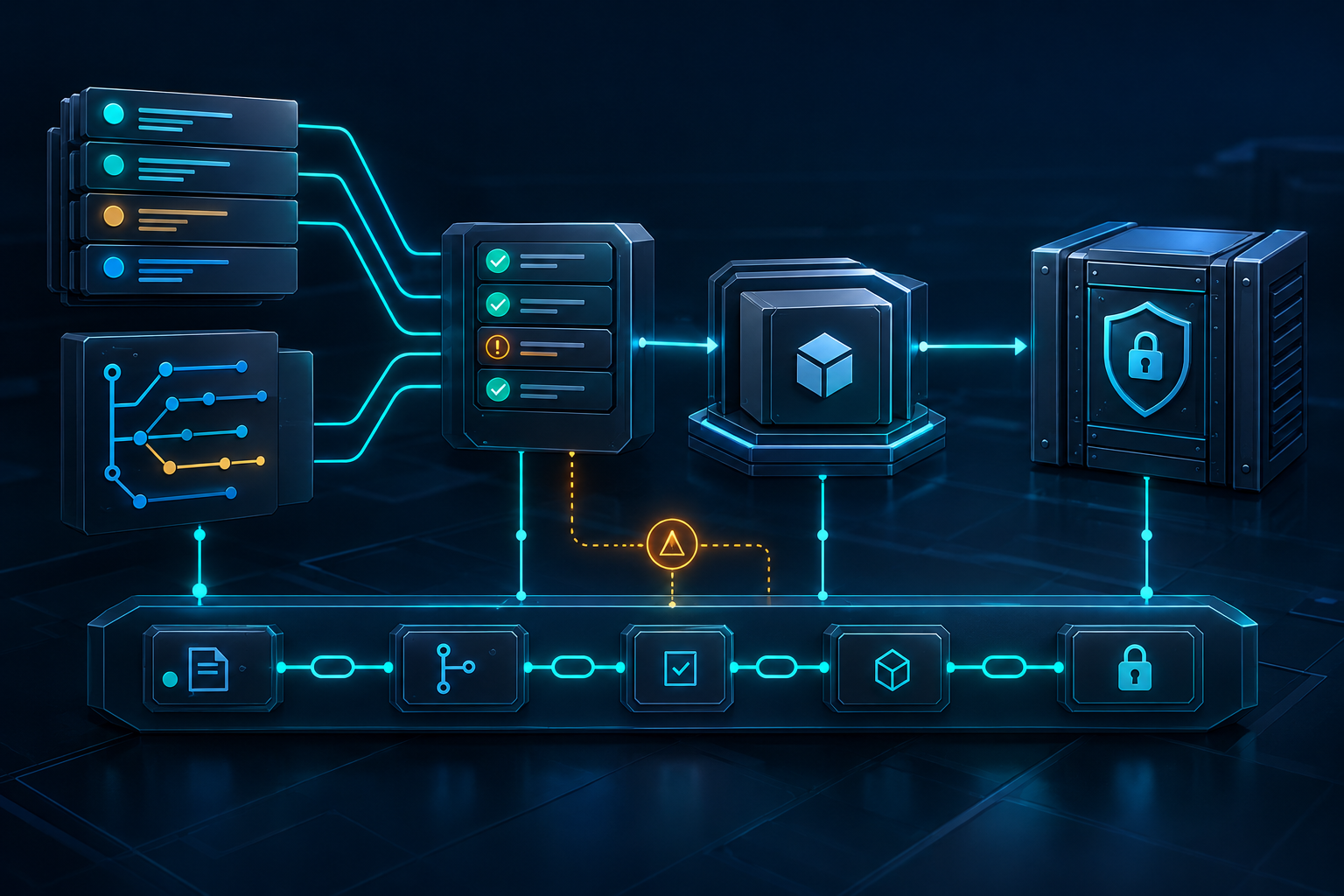
A Jira ticket and a GitHub pull request can both look complete while still failing to prove a change control.
The missing link is usually correlation. The ticket shows authorization, GitHub shows technical review, CI shows tests, and the deployment platform shows a release. Unless those records identify the same revision and preserve the order of events, an auditor still has to trust a manual explanation.
This workflow creates a testable evidence chain for SOC 2 change management. It fits within the broader AI Compliance Automation Guide and the operating model in How to Automate Change Management Compliance with AI.
Define the evidence contract
Before configuring integrations, decide what a complete sample must contain. A practical contract includes:
- Jira change key and immutable ticket URL
- Requester, owner, service, environment, and risk class
- Required approvers and approval timestamps
- GitHub repository, pull request, commit SHA, and reviewers
- Status of required CI and security checks
- Production deployment ID, environment, actor, and timestamp
- Post-deployment validation or rollback result
- Exception record when any requirement was bypassed
The contract should distinguish source facts from generated summaries. Jira, GitHub, CI, and deployment logs remain the sources of truth. A compliance record stores their identifiers, timestamps, relationships, and evaluation result.
This is the same evidence discipline used in automated SOC 2 evidence collection: every artifact needs scope, provenance, freshness, and a clear relationship to the tested control.
Create one correlation rule
Use the Jira change key as the shared reference across systems.
Require it in:
- The branch name or pull-request title
- The pull-request description
- CI build metadata
- The deployment event or release annotation
Then preserve the commit SHA from GitHub through the build and deployment process. The change key connects the business workflow; the SHA proves which revision moved.
Do not rely on fuzzy title matching as the primary method. AI can propose a connection for older or incomplete records, but a reviewer should confirm it before the sample passes.
Collect the Jira record
Capture the ticket state at meaningful control points, not only after closure.
Request evidence
Collect the service, environment, business reason, risk, implementation plan, test plan, and rollback plan. Record field values and timestamps so later edits do not erase what approvers saw.
Approval evidence
Capture the approver identity, role, decision, and timestamp. Resolve the identity against the authorized group effective at that time.
A comment that says “looks good” is not automatically an approval. Use a defined approval transition or structured field.
Exception evidence
If required data or approval is missing, link a governed exception with scope, compensating control, approver, and expiry. The exception lifecycle should follow a defined policy enforcement and exception management workflow.
Collect the GitHub record
For each linked pull request, retain:
- Repository and pull-request identifier
- Base and head branches
- Author and reviewer identities
- Review decisions and timestamps
- Required status-check results
- Merge actor, method, timestamp, and resulting SHA
- Relevant branch-protection state
Capture the branch-protection or ruleset configuration separately as control-design evidence. Pull-request records demonstrate operation; repository rules demonstrate how the preventive mechanism was configured.
Review dismissal and force-push events matter. If the approved content changed after approval, the workflow should determine whether policy required a new review.
Connect CI and deployment proof
A passing CI run is only useful when it is tied to the deployed revision.
The evidence pipeline should verify:
1. The CI run evaluated the pull request's approved commit.
2. Required checks completed successfully before the production gate.
3. The build artifact has a durable digest or identifier.
4. The deployment used that artifact.
5. The target was the expected production environment.
6. The deployment occurred after the required approvals.
7. Post-deployment checks completed when required.
This sequence separates evidence presence from control effectiveness. All artifacts may exist while the timing or revision relationship still fails.
Apply deterministic tests
Use rules for objective assertions:
- Change key exists in the required systems
- Jira approval predates production deployment
- Pull-request approval applies to the deployed SHA
- Requester is not the only approver
- Required checks passed before deployment
- Deployed artifact derives from the approved revision
- Emergency classification has a retrospective-review task
Use AI for narrower interpretation tasks:
- Suggest a risk class from ticket narrative
- Extract the likely service and environment
- Summarize a failed evidence chain
- Propose a match for an unreferenced deployment
- Group recurring missing-evidence patterns
A model should not manufacture a key, infer that a test passed, or convert an after-the-fact approval into a preventive control pass.
Example evidence evaluation
A change ticket is approved at 14:05. The pull request receives its required review at 14:12, CI completes at 14:18, and production deployment starts at 14:24.
The deployed SHA matches the approved pull request, and the deployment identity is authorized. The sample passes the timing and revision checks.
Now change one fact: the developer force-pushes at 14:20 and the repository does not dismiss the prior review. If policy requires approval of the final revision, the workflow should fail the sample or request evidence that the change remained within an allowed rule. It should not accept the existence of an earlier approval as sufficient.
Handle incomplete samples
Route incomplete samples while the context is still fresh.
- Missing change key: send to the deployment owner for correlation
- Unknown approver role: send to the control owner for identity validation
- Failed required check: create remediation with the CI result attached
- Revision mismatch: escalate as a potential unauthorized deployment
- Late approval: record a control failure; do not backdate the decision
- Approved exception: retain the exception and schedule its closure review
Track these items through the same workflow used to prepare for compliance audits, so open gaps remain visible before sampling begins.
For urgent production work, use the bounded process in How to Govern Emergency Changes with ServiceNow and AI instead of weakening the normal path.
Produce the audit view
For each selected sample, present a compact timeline:
1. Request opened and classified
2. Required approvals completed
3. Final revision reviewed
4. Required checks passed
5. Artifact built and identified
6. Artifact deployed to production
7. Outcome validated
8. Exceptions or remediation closed
Include direct source links and retain the underlying snapshots according to policy. The generated narrative should explain the validated sequence, not substitute for it.
How Layer8 Compliance helps
Layer8 Compliance can normalize Jira, GitHub, CI, and deployment evidence into control-aware records, flag broken relationships, and route missing proof to owners. Reviewers retain authority over ambiguous matches, exceptions, and final control conclusions.
Conclusion
Complete SOC 2 change evidence is a chain, not a collection of screenshots.
Use one change key across Jira, GitHub, CI, and deployment metadata. Preserve the approved commit through the release process. Test timing, identity, revision, and environment with deterministic rules, then use AI to classify context and accelerate review. That produces samples an auditor can follow without rebuilding the release history by hand.