How to Automate Change Management Compliance with AI
Learn how to connect change requests, approvals, deployments, exceptions, and evidence so change controls stay testable between audits.
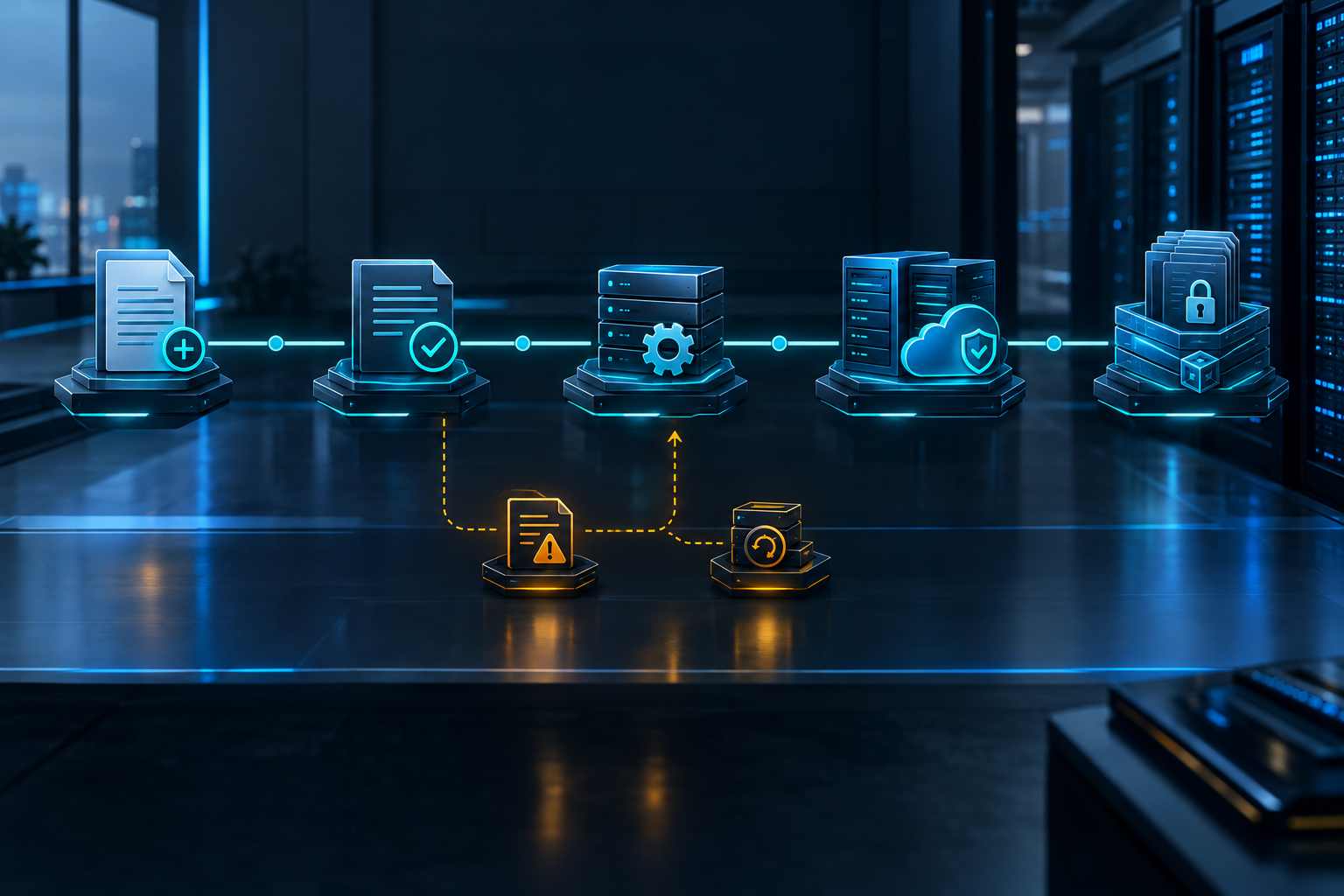
Change management controls often look healthy until an auditor asks for one complete sample.
The ticket has an approval, the pull request has a review, the deployment platform has a production event, and the rollback test lives somewhere else. Each record exists, but nobody can prove they describe the same change without manually reconstructing the timeline.
AI can reduce that reconciliation work. The useful pattern is not asking a model whether a change was compliant. It is using AI to classify records, connect related artifacts, identify missing proof, and route ambiguous cases to a control owner.
This guide explains how to automate that workflow while keeping approval authority, exception decisions, and control conclusions with accountable people. For the broader operating model, start with the AI Compliance Automation Guide.
What change management compliance automation means
Change management compliance automation creates a traceable relationship between:
- The business or technical reason for a change
- Risk and impact classification
- Required reviewers and approvals
- Test results and security checks
- The deployed revision and target environment
- Rollback preparation
- Exceptions and emergency procedures
- Post-implementation validation
- Evidence retained for the required period
The output is not a larger pile of tickets. It is a normalized change record that can be tested consistently.
A useful canonical record includes a change identifier, repository or service, owner, risk tier, approvers, source revision, deployment identifier, timestamps, evidence links, exception state, and final control result. Source systems remain authoritative. The compliance layer preserves the relationships and review history.
Why manual change evidence breaks
Approval and deployment records do not share an identity
A Jira request may use a project key, GitHub uses a commit SHA, and a deployment platform assigns its own run identifier. If those identifiers are not linked when the change happens, audit preparation becomes a matching exercise.
Control requirements vary by risk
A documentation update should not follow the same path as an identity-policy change. Static checklists either overburden routine work or under-control high-risk changes.
Approval is easy to confuse with review
A pull-request review proves that someone reviewed code. It does not automatically prove segregation of duties, business authorization, security approval, or production release approval. The required evidence depends on the control design.
Exceptions disappear into narrative
Teams often record an exception in a comment, ship the change, and never create an expiry date or compensating action. That creates an open risk without a durable owner.
Point-in-time sampling misses drift
A clean sample at audit time does not show whether teams bypassed the process during the rest of the period. Continuous checks are more useful because they surface missing fields and broken integrations while records are still easy to correct.
The control model to define first
Automation only works when the underlying control is explicit. Define the following before connecting systems.
Change classes
Use a small, stable taxonomy such as:
- Standard: repeatable, pre-authorized, and low risk
- Normal: planned work requiring risk-based review
- Emergency: urgent work using an accelerated approval path
- Administrative: non-production or documentation work with reduced requirements
Each class needs entry criteria. Do not let requesters choose a lower-risk class without validation.
Required evidence by class
Build an evidence matrix. A normal production change might require an approved request, peer review, automated test results, deployment proof, and rollback plan. A high-risk database migration may also require a restore test and post-deployment validation.
Segregation rules
State which combinations are prohibited. For example, the requester may be allowed to deploy but not provide the only approval. Service accounts need ownership and an approved automation role rather than being treated as human reviewers.
Timing rules
Define whether approval must occur before merge, before deployment, or before a production gate opens. A timestamp matters because a valid approver acting after deployment does not satisfy a preventive approval control.
Exception behavior
Every exception needs a reason, approver, scope, compensating control, expiry, and closure condition. The workflow should treat exceptions as governed records, not free-text explanations. The existing guide to compliance policy enforcement and exception management provides a deeper model for that lifecycle.
Reference architecture
A practical design has five layers.
1. Source integrations
Collect records from change tickets, source control, CI, deployment systems, cloud audit logs, and incident platforms. Prefer event-driven ingestion where possible, with scheduled reconciliation for missed events.
2. Identity and correlation
Map human identities, service identities, repositories, services, and environments. Correlate records using deterministic keys first: ticket references, commit SHAs, deployment IDs, and service catalog entries.
AI can suggest a match when identifiers are incomplete, but suggested links should carry confidence and require review when the match affects a control result.
3. Policy evaluation
Evaluate objective requirements such as:
- Approval happened before production deployment
- The approver held an allowed role at that time
- The requester was not the sole approver
- Required checks passed for the assigned risk tier
- The deployed revision matches the approved revision
- An emergency change has a scheduled retrospective review
Keep these tests deterministic. Use AI to interpret narrative risk, classify evidence, and explain gaps—not to silently override a failed rule.
4. Workflow orchestration
Route missing evidence and failed tests to the right owner. Include the failed requirement, linked source records, due date, and acceptable closure evidence. This is the bridge between detection and remediation.
5. Evidence and reporting
Retain source, timestamp, hash or source identifier, collector version, policy version, decision history, and reviewer actions. The principles in SOC 2 audit evidence collection apply directly: evidence should be current, scoped, attributable, and reproducible.
End-to-end workflow
Step 1: Open and classify the request
The requester identifies the affected service, environment, reason, expected impact, implementation plan, test plan, and rollback method.
AI can summarize the request and suggest a risk class based on affected assets and change language. The requester or designated reviewer confirms the class.
Step 2: Resolve policy requirements
The policy engine translates risk class and asset context into required approvals and checks. A production authentication change might require service-owner, security, and operations approval; a standard maintenance change may rely on a pre-approved procedure.
Step 3: Connect engineering artifacts
The workflow requires the change identifier in the branch, pull request, or deployment metadata. It then links commits, reviews, checks, and build artifacts to the request.
For implementation details, see How to Collect SOC 2 Change Management Evidence from GitHub and Jira.
Step 4: Enforce the production gate
Before release, validate the approved revision, required checks, reviewer roles, and approval timing. Failed requirements should block the gate where policy permits or create an explicit exception workflow where it does not.
Step 5: Capture the deployment event
Record what revision reached which environment, when it happened, which identity initiated it, and whether the approved deployment method was used. This closes the gap between “approved code” and “code actually running.”
Step 6: Validate the outcome
High-risk changes should produce a post-implementation check. Capture monitoring results, smoke tests, incident links, or rollback execution. A successful deployment event alone does not prove the change achieved its intended state.
Step 7: Close or escalate
If all tests pass, mark the control sample complete. If evidence is missing or a rule fails, create a remediation item with ownership and a due date. Track repeat failures through the same operating model used to remediate failed compliance controls.
Emergency work needs a separate, bounded path. The workflow in How to Govern Emergency Changes with ServiceNow and AI shows how to preserve speed without losing retrospective review.
Example: a production identity-policy change
A platform engineer opens a normal change for a production identity policy. The request references the service catalog entry and describes the expected access impact.
The automation:
1. Classifies the asset as high impact and proposes the high-risk change tier.
2. Requires platform-owner and security approval before deployment.
3. Links the Jira request to the GitHub pull request through the change identifier.
4. Verifies that the requester is not the sole reviewer.
5. Attaches CI results and the policy simulation output.
6. Confirms that the approved commit SHA matches the deployed revision.
7. Collects the cloud audit event showing the production update.
8. Opens a post-change validation task for access and authentication tests.
9. Stores the completed record with policy and evidence versions.
If the security approval arrives after deployment, the system does not rewrite the sequence into a pass. It records a failed preventive control, routes remediation, and preserves the late approval as part of the history.
Where AI helps—and where it should stop
AI is useful for:
- Suggesting change classes from request context
- Extracting services, environments, and risks from narrative
- Matching artifacts when deterministic references are incomplete
- Summarizing missing evidence for reviewers
- Grouping recurring failure patterns
- Drafting audit narratives from validated records
AI should not independently:
- Approve its own risk classification
- Invent missing evidence
- Treat a likely artifact match as proven
- Grant an exception
- Change a failed deterministic test into a pass
- Close remediation without verified evidence
Confidence thresholds should change workflow behavior. High-confidence classification can prefill fields. Medium-confidence results require confirmation. Low-confidence results should route to manual triage.
Metrics that expose control quality
Track operational metrics that reveal whether the control works:
- Percentage of production deployments linked to approved requests
- Percentage of approvals completed before the enforced gate
- Missing-evidence rate by team and change class
- Emergency-change rate and retrospective review age
- Segregation-of-duties failure rate
- Percentage of deployed revisions matching approved revisions
- Exception age and overdue closure count
- Repeat failure rate by control requirement
Do not optimize for ticket volume. A large number of closed requests says little about control effectiveness.
Rollout plan
Start with one production service and one normal-change path. Normalize identities and enforce deterministic links between the ticket, pull request, and deployment. Run the checks in observation mode long enough to identify legitimate workflow variants.
Next, add production gating for a narrow set of high-confidence requirements. Then add exception and emergency-change paths, followed by post-implementation validation and cross-service reporting.
Document rule ownership and version changes throughout the rollout. Auditors need to understand not only the evidence, but how the system decided whether evidence was sufficient.
How Layer8 Compliance helps
Layer8 Compliance can help connect control requirements, source evidence, reviewer decisions, and remediation workflows without making AI the approval authority. The practical goal is a reviewable chain from requested change to verified production outcome.
Conclusion
Change management compliance becomes reliable when every production event can be traced to the right request, approval, test, revision, deployment, and outcome.
Define the control model first. Correlate with deterministic identifiers wherever possible. Use AI for classification and reviewer acceleration, preserve human authority for ambiguous or risk-bearing decisions, and route every failed test into owned remediation. That turns change evidence from an audit-season reconstruction into a continuous operational record.